It's Sukkot, and We Don't Need to Invite Jonah
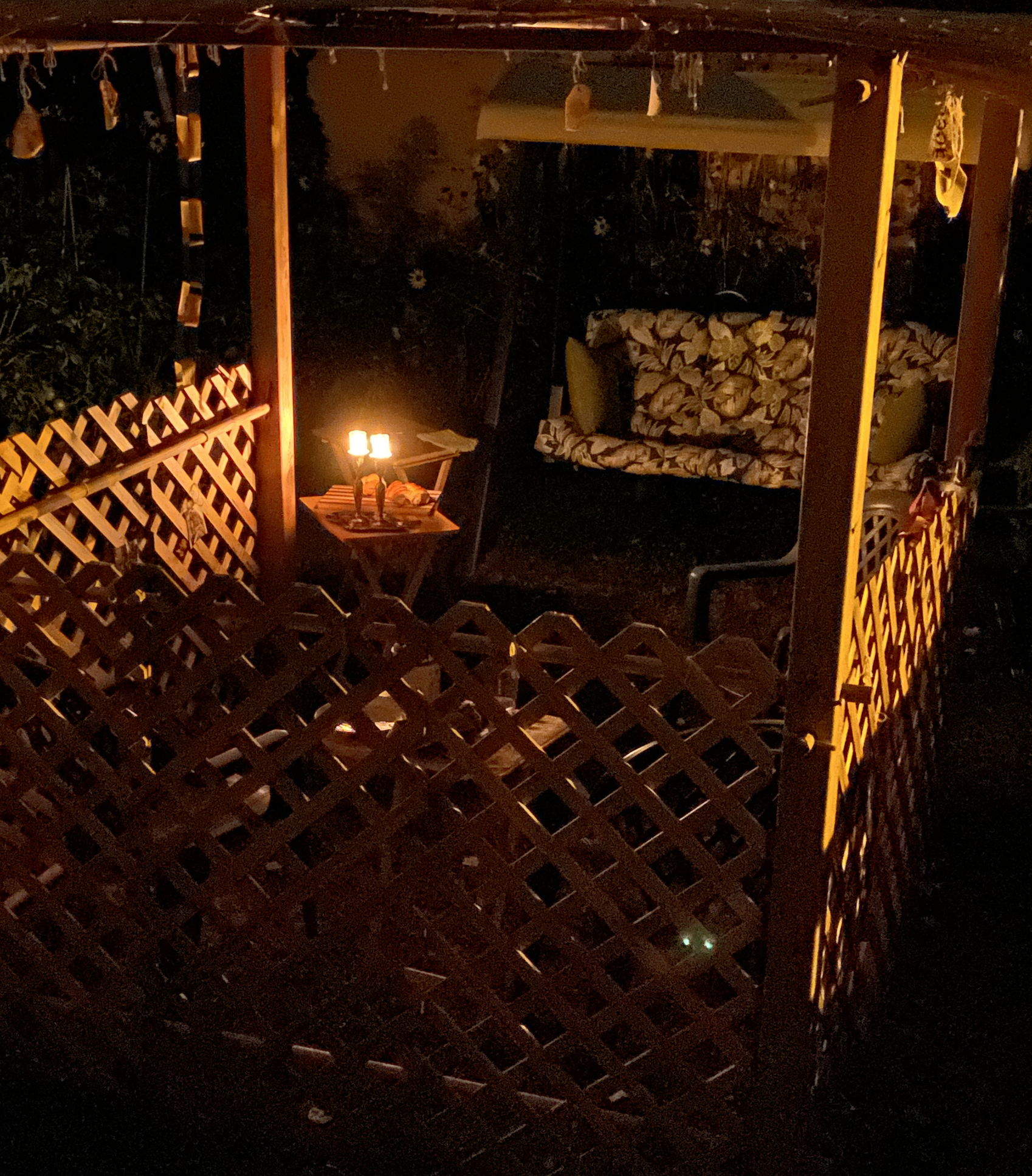
A sukkah at night, two lit candles glowing to light it up, some decorations, and a table and chairs. We are looking into the sukkah from outside.
I’ve long said our sukkah is a portal that connects us to every other sukkah in the world, now and backward and forward throughout all time and space.
In this four-day bridge between Yom Kippur and Sukkot, Liddy and I will soon get out our sukkah parts so we can build our sukkah, but I am still thinking of and really feeling for Jonah. This morning it landed on me differently that after Jonah has spoken to Nineveh and they’ve repented and God has forgiven them, Jonah builds himself a sukkah to the east of the city.
In Merchav, on Rosh HaShanah we studied about prophets and Sarah as a prophet. On Yom Kippur we spent the day with the prophet Jonah, deeply considering the 4 chapters of 48 verses of his story. You can read our Reader’s Theater Style Version here if you’d like to or the original in Sefaria here. In my reader’s theater retelling, the narrator and the characters speak text lifted directly from the original with some interpretive translation, the “readers” speak commentary and share history - some from other sources and some of my own all blended together.
While many brilliant Jewish scholars seem to have little compassion for Jonah as he sits to the east of that brutal, while for the moment repentant, city of Nineveh in a sukkah and identify us on Yom Kippur with Nineveh called to repent and repenting, that just isn’t what I see in the story. If the story were about Nineveh’s teshuvah, repentance and return, it seems to me it would have ended after Chapter 3. For that matter, I think it might have detailed what the “wickedness” of Nineveh actually was. What did they identify as the harm they’d done? How did they commit to becoming people who would never do that harm again? When did they apologize to the people who they’d harmed? What repair did they seek to make? This is the work of teshuvah, after all.
The story we inherited leaves even the question of their specific wickedness unclear; although our ancestors, almost certainly writing the story many centuries later while in exile in Babylon, absolutely knew.
Nineveh was the capital of the Assyrian Empire, and the Assyrian Empire actually recorded its own brutality. I won’t get into that here, but the history is out there for you to find if you want to. After the time in which the story of Jonah is set and before the Babylonian destruction of the Temple and the exile of the Jews of the Kingdom of Judah, the Assyrian Empire destroyed the Northern Kingdom of Israel and effectively erased the 10 northern tribes. 10 of the 12 tribes of Israel. All that was left by the Babylonian exile were the tribes of Judah and Benjamin. Once we get to the story of Esther in the Persian Empire, those are the only two tribes in the story.
Which I think means for the scribes of Jonah’s story, Nineveh’s wickedness wasn’t abstract. In fact it was so specific they didn’t need to describe it. Everyone knew. They could reference Nineveh the way we might reference 9/11, Chernobyl, October 7th, Gaza, the Trail of Tears, the Tulsa Massacre, the Holocaust, the Rwandan Genocide, the bombings of Hiroshima and Nagasaki, or the Trans Atlantic Slave Trade. Including, but not limited to. If we are adults and images do not immediately come to mind of each of those events, and many others, we have some learning to do.
In Jonah’s story, Nineveh’s repentance is only between Nineveh and God. And by the way, I can find no historical evidence of any actual moment of repentance of the Assyrian Empire. Later in measurable time, the Assyrian Empire destroyed the Northern Kingdom of Israel, an event which has abundant historical evidence.
Jonah had very good reasons not to do what God told him to do.
God, if you forgive Nineveh, in the future, the Northern Kingdom of Israel will be destroyed. And God forgives Nineveh anyway.
Gut. Punch.
I did find a scholar from the 16th century CE, Isaac ben Judah Abarbanel, who saw what I see. Abarbanel proposes that Jonah feared the future destruction of Israel by Assyria and, as Nineveh was the capital city of Assyria, Jonah initially chose to martyr himself for his people rather than obey God. He left for Tarshish, he told the sailors to hurl him into the sea, he expected to die and was instead swallowed by a “very big fish”, he prayed, the fish spat him out onto dry land, and off he went - though not enthusiastically - to Nineveh. He wanted to die rather than play a part in God forgiving Nineveh, and God in the story would not let him.
We know Nineveh will be forgiven from Chapter 1 because we’ve read this story before. The thing is, Jonah also knows Nineveh will be forgiven from Chapter 1. How? Well, I think because the Jews by the rivers of Babylon who wrote the story knew that the Assyrian Empire would live to maim, murder, and plunder another day.
So when Jewish scholars and rabbis and all kinds of people pile on judgment for Jonah because he ran, calling him a “reluctant prophet” or disparaging him for his hostility toward Nineveh and his unwillingness to accept Nineveh’s repentance, well . . . I mean, whose side are we on here? As I read it, Jonah is the one on our side, and I want to be on his. Not only that, if we could just slow down a bit when we read this story, how could we not see ourselves in him?
Most immediately, if the man who shot Const. Jeff Smith of the Belleville police in Ontario on Erev Yom Kippur while Smith was providing security for Sons of Jacob Synagogue just tells God he is so very sorry, are we all going to feel okay with that being the end of the conversation about him? Should Jeff’s wife and children be expected to consider it repair enough if they are told the shooter repented to God? What about the mayor who is quoted as saying, “everyone has the right to feel safe”? Is that enough for us? (How about be safe, Mayor?)
I think about all of the places God could tell me to go to help the people there realize to any degree the harm they’ve done so that they can apologize to God that I 100% would not agree to go. Not even for God. I’m no prophet, but good grief can I empathize with Jonah.
When so many scholars and rabbis chastise Jonah for slumping into depression, bursting into frustration with God, despairing, insisting he was right all along to flee when he was first called, and say it’s not clear why Jonah would be so angry . . . and express judgment on Jonah - even going so far as to call him the “anti-prophet” - for being upset that God has forgiven such an (in their own words) evil city . . .
Well, I mean, what am I missing here?
What, exactly, has Jonah done wrong?
And where does it show, anywhere in these four chapters, that God is judging Jonah for Jonah’s actions? Where is Jonah punished? I’m not a Hebrew scholar, maybe I just haven’t seen it.
Or maybe we’ve just been told by nearly everyone other than Abarbanel that Jonah was in the wrong.
If Jonah is in the wrong, that would leave us in a world in which if the ADL accepts someone’s apology for something they did that was virulently antisemitic all Jews have to just be okay with it for all time no matter what that person does in the future.
That would mean that if a man who has drugged and raped dozens of women makes some kind of apology all of the women he harmed have to accept the apology and want nothing more than for him to be forgiven and ‘get his life back’.
That would mean if a state changes its racist flag and some percentage of people in that state start making land acknowledgment statements, all indigenous people in the state should forgive the theft of land, massacres, Indian schools, and all other atrocities that have harmed their ancestors and them and have financially benefitted the state for now hundreds of years.
That would mean as long as some representative of the Confederate Cause makes some kind of motion toward . . . surrender, I guess . . . and the United States officially “forgives” the south, all African Americans should accept that forgiveness because everything is okay now.
Obviously I am not okay with that world. I’m with Jonah.
The “east” of anything in Jewish narrative often means exile. So here I sit with Jonah in the sukkah he just built to the east of Nineveh waiting to see what would happen to that city. Some say he’s waiting, hoping they’ll be destroyed yet. Maybe. If so, I get that. Or maybe he’s waiting through the centuries, like Rachel who will watch her children go into exile and weep, for when Nineveh turns on the Northern Kingdom.
Some have Jonah sulking.
Not me. I think Jonah is crying.
Our tradition tells us to read this story during the final stretch of Yom Kippur. We’ve done so much praying and before that so much introspection. We’ve sought to make amends. We’ve committed to amends. We’ve determined to be different from the person we were when we committed harm against someone. We are empty. Spent. Exhausted.
And then we read of this city of people who harmed us. And God forgave them.
Yes, I’ve just been seeking forgiveness from God myself, but first I sought forgiveness from the people I harmed. I did real work of repair with them. Or if for harm I did to myself, I worked to make plans and commitments so I won’t in the future. I’ll respect my need for sleep more, I’ll nourish myself more. Two things I am dramatically not good about. Only then did I turn to God.
But Nineveh? They only turn to God.
Must I forgive someone who hasn’t done the work for me to be able to believe that they are now a person who would no longer be able to hurt me in the way they did?
Is Jonah being expected to forgive Nineveh, or even accept that God has forgiven Nineveh?
I don’t think so.
We are under no obligation in Judaism to forgive someone who has caused us harm even if they’ve done the work of teshuvah, even if they’ve apologized and we’ve accepted their apology. Whether we hold onto our anger or fear or whatever we are feeling is up to us, too. While we are obligated to offer a tochecha, a rebuke or constructive criticism or a calling in or out if we believe the person who has harmed us has capacity to and interest in change, we are also told NOT to offer a tochecha to someone we do not believe can or wants to change or if it would put us in harm's way. Our obligation is to seek repair when we have caused harm.
So no. I don’t think Jonah needs to forgive Nineveh.
I think Jonah has to figure out how to live in a world in which there are Ninevehs, a world in which Ninevehs aren’t stopped from causing harm and even thrive in the very harm they are causing.
Just as we do.
I think sitting in his sukkah Jonah is trying to understand God. He is a prophet after all, he is in this tight relationship with God, a mutual relationship, intimate. Heschel says a prophet keeps God and humanity in mind at the same time all the time. Buber says that being a prophet means being in constant dialogue with God.
In Chapter 4 God asks Jonah, is their forgiveness this upsetting to you?
And Jonah says, “Yeah, it is. And, God, I am right to be this upset.”
For what it’s worth, I agree. I am sitting in Jonah’s sukkah with him and I am also upset. This upset. So upset.
What’s more, God doesn’t say he’s not.
God doesn’t erase Jonah’s feeling.
God tries to explain God’s self.
Maybe God does a good job of it, maybe not, but that’s what I see at the end of the chapter. I see God trying to explain to Jonah why it is that God has forgiven Nineveh. God’s explanation ends in a question, a kind of, “What else can I do? 120,000 people who don’t even realize the harm they are causing. And cattle.”
Thinking about building our sukkah later today, I’m thinking about the Ushpizim, the ancestors we traditionally invite. By the Zohar we have Abraham, Isaac, Jacob, Moses, Aaron, Joseph, and King David. Contemporary female guests we have Sarah, Miriam, Deborah, Hannah, Abigail, Huldah, and Esther.
Maybe we don’t need to invite Jonah.
Maybe he’s been sitting there since the 8th century BCE, or since the Babylonian exile, waiting for us in the hopes of helping us figure out how to live in our world . . . and how to build ourselves places of rest within it.
Is there one of us who couldn’t use a little help with that?
Sukkot this year begins Friday evening September 25th.