Hineini, Hineini: Parshat Shoftim

A bridge all lit up with rainbow lights.
They aren’t super neat or well-edited, but I have some thoughts to share about Elul and this week’s Torah portion.
When I came out of the bathroom today at one of the medical clinics I’ve been frequenting, that was the picture hanging on the wall in front of me. It isn’t a mistake. It isn’t incidental. It is right outside the gender neutral bathrooms in a medical clinic.
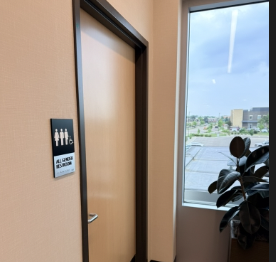
A medical clinic bathroom door with a sign that has a figure in a skirt, a figure in half skirt/half pants, and a figure in pants with the words, “gender neutral bathroom.”
That photo on that wall in that place is someone’s fierce pursuit of justice.
And kol hakavod. I’m here for it.
This week’s parsha is called Shoftim.
Shoftim means judges, and judges have the job of knowing the law, listening to what everyone says, looking at the evidence, and making a fair or “just” decision. If a judge’s decision doesn’t seem right to one side in the conflict, the case can go to a court with more authority to review that decision. That’s called an appeal. Judges roles in the Torah and in the United States aren’t exactly the same, but it’s a similar idea. Torah judges are supposed to know JEWISH law and help the Jewish community be fair and do the right thing.
In Merchav Shabbat this shabbat, we will chant these three verses:
Deuteronomy 16:18-20
You must appoint judges and legal officials for your tribes, in all the places that Adonai your God is giving you to live, and they must govern the people with justice.
You must not judge unfairly: you must not be unfair; you must not take bribes, for bribes keep a judge from knowing right and wrong and make it so they can’t hear the what a person who is doing the right thing - who is “just” - is saying.
Justice, justice shall you pursue, that you may thrive and live in the land that Adonai your God is giving to you.
Tzedek, Tzedek tirdof. Famous Torah phrase.
In Talmud Sanhedrin 32b it reads:
“As it is taught in a baraita (an ancient rabbinic law): When the verse states: “Justice, justice, shall you pursue,” one mention of “justice” is stated with regard to judgment and one is stated with regard to compromise. How so? Where there are two boats traveling on the river and they encounter each other, if both of them attempt to pass, both of them sink, as the river is not wide enough for both to pass. If they pass one after the other, both of them pass. And similarly, where there are two camels who were ascending the ascent of Beit Choron, where there is a narrow steep path, and they encounter each other, if both of them attempt to ascend, both of them fall. If they ascend one after the other, both of them ascend.”
The Hasidic master Rabbi Simcha Bunim of Peshischa taught that the repetition means justice must be pursued only through just means. In other words, the ends do not justify the means. You cannot lie, manipulate, or cut corners even in service of a righteous outcome, because an unjust path corrupts the just goal you're chasing. A tzedek achieved through injustice is not tzedek at all.
The Kotzker Rebbe offered another reading: the first tzedek is for others, the second is for yourself. It is easy to demand fairness when we are wronged. It is much harder to hold ourselves to that same standard when we are the ones with power, or when justice would cost us something. The verse insists: pursue it in both directions.
Ibn Ezra reads the repetition as intensification, a Hebrew idiom for urgency.
He taught it is as if this verse says, "justice, and only justice, relentlessly."
Maybe you’ve heard all of that before, but have you put those verses together with Shoftim’s Haftarah from Isaiah? I hadn’t. I’ll share what I uncovered, but first, a tangent I think is interesting.
In many communities, on Shabbat and holiday mornings, in addition to chanting from the Torah, we also chant from one of the biblical books of the Prophets after the Torah reading. The portion is known as the haftarah (hahf-tah-RAH, or it can also be pronounced: hahf-TOH-rah). It looks like this in Hebrew: הַפְטָרָה. The shoresh for “haftarah” is פ-ט-ר. The infinitive verb לְהַפְטִיר (l’haftir) means to conclude, dismiss, or depart. פָּטַר (patar) means to release from an obligation, exempt or excuse. The person who is to read the haftarah is called to the Torah for a last, additional aliyah called “maftir.” “מַפְטִיר” (maftir) shares the pey-tet-reish root with Haftarah. This last aliyah is an addendum to the Torah reading. Several verses at the end of the last aliyah of that day’s Torah reading are repeated in the aliyah read by or for the maftir.
The weeks between Tisha b’Av and Rosh HaShanah are called the 7 weeks of Consolation. The haftarah readings for these weeks are meant to be comforting. Isaiah 51:12-52:12 is the 4th of the 7 Haftarot of consolation, and this week’s haftarah portion.
Okay, back to the main thread. Let’s take a look at 51:12 and 52:6.
51:12
לָכֵ֛ן יֵדַ֥ע עַמִּ֖י שְׁמִ֑י
לָכֵן֙ בַּיּ֣וֹם הַה֔וּא
כִּֽי־אֲנִי־ה֥וּא הַֽמְדַבֵּ֖ר הִנֵּֽנִי׃
I, I am the One who comforts you!
What ails you that you fear
Man who must die,
Mortals who fare like grass?
52:6
לָכֵ֛ן יֵדַ֥ע עַמִּ֖י שְׁמִ֑י לָכֵן֙ בַּיּ֣וֹם הַה֔וּא כִּֽי־אֲנִי־ה֥וּא הַֽמְדַבֵּ֖ר הִנֵּֽנִי׃
Therefore, My people shall learn My name,
Therefore [they shall learn] on that day
That I, the One who promised,
Am now at hand.
Hineini is that last word translated as “Am now at hand” on Sefaria (JPS). More literally we could read, “Here I am.”
If tzedek tzedek teaches that justice must be pursued in every direction, outward and inward, in letter and in compromise . . . then Isaiah's doubled "therefore" could be read as building toward an unavoidable, doubly-certain outcome. Not maybe, but definitely. Tzedek tzedek tirdof could be read as the human mechanism by which Isaiah's promise gets fulfilled. Maybe pursuing justice is how God's name becomes known in the world. The word hineni here is God's own answer to being called. We also have: Abraham's hineni at the Akedah, Moses' at the burning bush. In Isaiah, God says it of God’s Self: I am the one who speaks. Hineni. Maybe this as a model for what tirdof (pursuit) is supposed to produce. When we pursue justice relentlessly, we're meant to become the kind of people who answer "hineni" when someone needs us. Justice pursuers and God both show up.
Shofet means judge. Parashat Shoftim gives us judges, courts, and the demand: tzedek tzedek tirdof, justice, justice you shall pursue. Its haftarah, the fourth in the the seven haftarot of consolation read between Tisha B'Av and Rosh Hashanah, opens with God saying, Anochi anochi hu menachemchem, "I, I am the one who comforts you" (Isaiah 51:12). Justice and comfort, spoken in the same breath, doubled the same way, on the same Shabbat.
That’s Elul for you.
Judgment alone, cheshbon hanefesh without comfort, becomes despair. If all Elul gives us is a mirror and a court, we might look honestly at what needs fixing and conclude we are unfixable. That's not humility, that's collapse, and collapse doesn't lead anywhere. We can't rebuild from a place of pure self-prosecution. At the same time, comfort without judgment becomes avoidance. If Elul only comforts us, it lets us stay exactly as we are. Comfort without honesty can just be another way to hide from ourselves.
Shoftim demands the court. Isaiah, in Shoftim’s haftarah, promises the comfort. This is exactly the emotional architecture of this whole season. We say Selichot and recite the Thirteen Attributes of God's compassion in the same month we do our hardest self-accounting. We stand before God the melech, the birthing king, the sovereign who judges; and we address that same God as avinu, our parent, who loves us. Rosh Hashanah is called Yom HaDin, the day of judgment, and its liturgy is saturated with tenderness. Yom Kippur, is the day of atonement when the judgments are sealed and the gates close with forgiveness.
Hineni is the bridge.
Maybe it’s even lit up with rainbow lights. In my brain, right now, at 2:30am, it’s lit up with rainbow lights.
“Here I am” is presence. It’s showing up in what is true. Judgment and compassion are both in the room. We can do it because we already know we will not be abandoned for it. Elul asks us to become people who can say “hineini” to our failures, to our triumphs, to the people we’ve hurt, to our keeping on keeping ons, and to ourselves.
So if you’d like, let’s lean toward that together.
Let’s take a few private moments in these first days of Elul and show up and be present and honest with ourselves about something we could have done better or a time we could have been better, and something we did well - maybe it was even a triumph.
What might we do to repair the harm we caused?
What might we do to hold onto and do more of the good stuff?
Let’s actually give those questions some time and some air.
Hineini. Hineini.
Shabbat Shalom.