Yitro’s Table: Food Justice Rooted in Torah
A Nourishing Celebration of Tu BiShvat and this Parsha
We have ONE MORE live workshop and tour left on Thursday evening Feb 5 (my birthday!) 6:30-8:30pm Central. If you would like to join me, please let me know here.
ALSO a note of honesty.
I’ve been working on this d’var Torah over a few weeks and with everything else going and my own limited capacity on I have run out of time to continue to edit it. One thing that means is it is 2-3 times as long as the diveri Torah I typically share here. If I’m being really honest, I’d also tell you that as I read through it there really isn’t anything I want to cut. Anyway, you are invited to read it as a draft. The alternative is I never post it . . . and there are ideas in here I’ve been working hard on that I’d really like to share.
Happy Tu BiShvat and Shabbat Shalom.
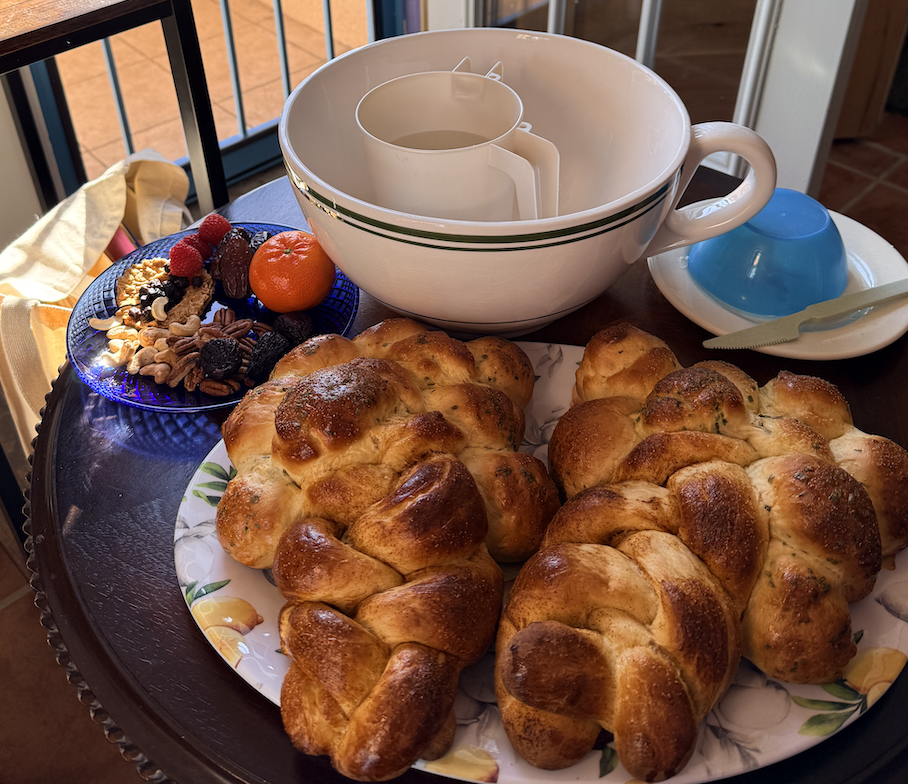
Two tree-shaped challot, dried fruits and nuts, a bowl and washing cup, and under a blue dish is butter. There is also a door in the picture, and it’s open.
During the week of Tu BiShvat, Merchav hosted two live MAZON Virtual Tours of the MAZON Hunger Museum. I also facilitated two Tu BiShvat seders - for youth 8+ and adults and for 3-6 year olds and their grown ups. We also had classes focused on learning about the history of hunger in the United States and what we can do about it together grounded in Jewish life, Jewish experience, and Jewish values.
Tu BiShvat is foundationally responding to the question:
How do we create structures in our society to make sure that everyone always has enough to eat - no exceptions?
This week’s Torah portion is Yitro.
What does Yitro have to do with feeding people?
How could Yitro possibly be connected with Tu BiShvat?
I’m so glad you asked!
Let’s get into it.
The Mishnah teaches:
“There are four new years … On the fifteenth of Shevat is the new year for the tree.” Mishnah Rosh Hashanah 1:1
If you have heard about Tu BiShvat before you may have heard that it’s the birthday of the trees, which is sweet. Or, you may have heard that it’s basically Jewish Arbor Day and we plant trees, which is important. Possibly you’ve learned that Tu BiShvat is Jewish Earth Day and we focus on environmentalism, which is necessary.
None of these ideas is wrong and all of them are ways folks observe Tu BiShvat.
However, Tu BiShvat also has a great origin story.
This day, the 15th of the month of Shevat, was initially not intended to be observed as a celebration of trees for their own sake, but as a legal and moral threshold. It marks the moment when tree fruit is counted toward tithes and offerings in the coming year - in other words toward systems designed to ensure that abundance circulates rather than accumulates. The new year of the trees is bound to societal questions of who eats, who goes hungry, who blesses, and how blessing is shared.
If we are paying attention, it isn’t at all a surprise that fruit trees become one of the foundations of Jewish ethics. Our Torah repeatedly links trees to human moral life.
In the beginning . . . okay, so not the very beginning, but pretty close to it . . . early in Genesis chapters 2 and 3, we meet all the trees pleasing to the sight and good for food, the Tree of Knowledge of Good and Evil, and the Tree of Life. In chapter 8 an olive leaf signals the end of the flood in parshat Noah. Abraham lives and builds altars and wrestles with the meaning of life and the universe near terebinth trees in Genesis chapters 12, 13, and 18. While the burning bush is translated as a, well, bush, in Exodus 3, traditional interpretations suggest it was a bramble or a thorny acacia tree that burned without being consumed and in proximity to which Moses has an intense chat with God. Wood from a tree at Mara turns bitter water sweet - Exodus 15 and in the same chapter when we came to Elim in the wilderness there was an oasis of 12 springs and 70 date palms representing the tribes and the elders.
That’s far from all, we’re just getting started!
The main body of the Ark of the Covenant, the planks, and the altar, are made from acacia trees in Exodus 25-27. In Leviticus 23 we are instructed to use the “fruit of the hadar tree” - interpreted by tradition as the etrog - in the four species during Sukkot. Good stewardship, says the Torah in Leviticus 19, requires caring for trees for three years before eating their fruit. Cedar and cypress trees often represent strength, royalty, and stability. Willow, also in the four species, represents water and community. And in later Talmudic literature carob trees are associated with our investment in the future.
I could go one, but I think you see what I’m saying.
In the Torah, trees are everywhere, and the rabbis of the Talmud emphatically, positively, and intimately connect trees with humans and specifically with human moral life.
“For is the tree of the field a human being?” asks Deuteronomy (20:19), and the rabbis famously invert the question and insist: the human being is like a tree of the field (see Talmud Ta’anit 7a). Like trees, teach the rabbis, humans depend on water, soil, patience, and care. Like trees, we are judged by what and how we give and share. Like trees, we are called into relationships of reciprocity.
Therefore, when we ask the question: How do we create structures in our society to make sure that everyone always has enough to eat - no exceptions? We look to trees for guidance.
When a tree makes its fruit - whether an almond, nectarine, rambutan, or serviceberry - it holds that fruit out on its branches for anyone hungry for that fruit to come and eat it. An oak tree doesn’t ask whether this particular squirrel deserves the acorn. A eucalyptus tree doesn’t remind a koala of everything they have ever done wrong before allowing them to eat a leaf. No bird has been turned away from ripe berries because they had the wrong feather color. Trees are quite clear. Everyone gets to eat, and everyone means everyone.
In about 200 C.E., guided by the trees, the Talmudic rabbis knew that as much as humans aspire to be like trees - we aren’t, and relying on spontaneous and charitable human generosity would not ensure that no one starves. They addressed the problem by creating a system of tithing. A tithe is the religious practice of contributing one-tenth (10%) of one’s income or produce to the community to be shared as needed. The system was intended to make sure that everyone who had enough food would share and everyone who needed food would have access to what others had shared.
Several of my students this week have pointed out that if everyone is giving all the time then the people who don’t have become people who have and that means they also become people who give. One of my students is growing up on a farm and they added that you never know which season is going to be the season you have or you need. Maybe, said one student, everyone ending up in a circle of giving and receiving is actually just . . . life. For sure, I thought. If we are paying any attention at all.
This tithing system the rabbis cooked up established that the fruit blossoms before the 15th of Shevat counted toward the previous year’s tithe and the blossoms after counted toward the next year’s cycle.
Now, the name of this date - Tu Bishvat - comes from the Hebrew letters that represent the number 15. In Hebrew, every letter is associated with a number. A direct 10-yud and 5-hay would use the first two letters in the 4-letter unpronounceable name for God, so instead the sages took the Hebrew letter tet - 9 and vav - 6 for 15 and that’s how we get “tu”.
You know how leaves change in the fall? Dot by colorful dot and then, if we weren’t paying attention all along, suddenly the whole aspen tree is shimmering yellow? Well, when I was very young, five or six, I was climbing a tree one early fall day and up in its branches I noticed some of those little dots and became convinced that grown-ups - at least those who did not climb trees - probably did not know that when leaves start to change it’s dot by dot like that. I felt like I had discovered a secret of the Universe.
I don’t know, but maybe, by counting this date of the 15th of Shevat with a tet and a vav we are leaving a trail of breadcrumbs in a forest, dots on leaves, to lead us to ask why are we adding 9 and 6 instead of 10 and 5. Maybe that “tu” is not actually meant to avoid God’s name, maybe it’s meant to get us curious, engage us, get us invested, help us discover secrets of the Universe. After all, in Leviticus 19:9-10, after we are commanded to leave the gleanings of our harvest and the fallen fruit in our vineyards for those in need, the words that follow are ani Adonai Eloheichem. I, Adonai, am all y’all’s God. Your plural. Your as a community, as a society. Maybe we are being nudged through time by our Talmudic ancestors, “Hey. Hunger isn’t individual failure. Hunger is social responsibility.” Maybe even in the date itself they were inviting us to realize, addressing hunger is on “all y’all.”
In the Middle Ages, Jewish mystics called kabbalists gave Tu Bishvat a different kind of spiritual meaning. In the 16th century, the kabbalist Rabbi Yitzchak Luria of Tsfat and his students instituted a Tu BiShvat seder in which the fruits and trees of the Land of Israel, especially of the Seven Species, were given symbolic meanings. The main idea was that eating ten specific fruits and drinking four cups of wine in a specific order while reciting the appropriate blessings would bring human beings, and the world, closer to spiritual perfection. They believed that physical objects contain hidden sparks of the Divine Presence and that our words and actions could help release these sparks back into the world - specifically appreciating, blessing, and eating fruit.
In the late 1800s and early 1900s, Jewish pioneers in Israel began planting trees on Tu BiShvat to help renew forests and the land that their ancestors once lived on.
On Tu BiShvat 1890, Rabbi Ze'ev Yavetz, one of the founders of the Mizrachi religious Zionist movement, took his students to plant trees in the agricultural town of Zikhron Ya'akov. This custom was adopted in 1908 by the Jewish Teachers Union and later by the Jewish National Fund. In the early 20th century, the Jewish National Fund devoted the day to planting eucalyptus trees to stop the malaria plague in the Hula Valley. Today the Fund schedules major tree-planting events in large forests every Tu BiShvat. Over a million Israelis take part in the Jewish National Fund's Tu BiShvat tree-planting activities.
Also in the late 18th and through the 19th century Jews in the diaspora - that means outside of Israel - became very involved in movements for food justice. These Hebrew Benevolent Societies were the earliest form of organized Jewish charitable aid in the U.S., focusing on mutual aid and providing for basic needs. Over time, these societies evolved into professional social service agencies (such as Jewish Family Service) and, in the modern era, have intersected with the New Jewish Food Movement, which merges traditional tzedakah (charity/justice) with environmental sustainability and systemic food security reform.
They usually didn’t connect those movements with Tu BiShvat, but they could have. Founded in Jewish values, they insisted that everyone should have enough to eat. They were saying that people who have enough to share should share it, and people who do not have enough should receive what’s shared and there should be systems in place (like tithing) to make sure that happens.
None of this history means that we as a people or within our organizations have always done the right thing where feeding people who are hungry is concerned. Not by a long shot. What it means, at least what it means to me, is that our tradition makes a solid argument that we should always be working to do better when it comes to making sure that everyone who is hungry has enough to eat.
Everyone and always.
By marking the year of the tree, the sages of the Talmud made abundance a shared obligation, ensuring that nourishment flows outward and is not hoarded, echoing the ancient rhythms of justice embedded in the soil. These rabbis declared the radical ethic that “Whoever sustains a single life is as if they sustained an entire world.” (Sanhedrin 37a) Therefore, Tu BiShvat is a time not only of planting trees and ecological awareness, but of food justice. It is an invitation to ask whether our systems of nourishment reflect the Torah’s vision of dignity and sufficiency for everyone.
Wonderful! you might be thinking.
But what does any of that have to do with Parshat Yitro?
Yitro lived and died long before Tu BiShvat was established.
You’re right. Of course, you’re right. And Parshat Yitro is best known for the giving and receiving of the Ten Commandments. We need to pay attention, though, because before thunder and fire, Yitro opens with something quieter: listening, food, welcome, and counsel in one of the most tender moments in the Torah.
When Yitro listens, Yitro listens.
Let’s go back in the Torah a bit and pause in the quiet of that listening.
The child Moses was born into hiding, raised back and forth by his princess mother in the palace and his enslaved mother among the Hebrews. He grew up knowing who his people were while also being educated as royalty. His inner struggles externalized when he witnessed the Egyptian beating an enslaved Israelite . . . or witnessed another Egyptian beating another enslaved Israelite . . . again and again and again, when would it end? Maybe it was killing him. Eventually, he killed one of them. Then he witnessed Israelites fighting amongst one another and discovered they knew he killed an Egyptian, or maybe that Pharaoh knew who he really was. Whatever he realized was known, Moses ran and ran and ran . . . ran so far until . . . a well and women being harassed by men. The wrongs in the world were so big and most of them he couldn’t fix, but this he could do something about. So he did. He ran off the harassers and helped the women with the water like his ancestor Rebecca had once helped someone with water.
“And the shepherds came and drove them (the daughters) away, but Moses arose and saved them, and he watered their flock.” (Exodus 2:17)
And Moses . . . what did Moses do when the daughters of Yitro went home and told their father about the Egyptian man who had helped them? I feel Moses’ displacement, vulnerability, and hunger. I see that he has almost nothing with him. In Midian he wasn’t known by his relationships - royal or enslaved. In Midian, he was a refugee. I imagine he sank down beside the well and wept as if it were the waters of Babylon.
And yet, though he didn’t know it, Moses was not alone.
The Torah tells us when the daughters returned home earlier than usual, Yitro - a Midianite priest - asked why, and they explained that an Egyptian man helped them. They didn’t even know Moses’s name. It was his kindness, not his status, that made him special. Yitro responded:
“‘Where is he? Why have you left the man? Call him, that he may eat bread.’” Exodus 2:20
I wonder what the expression was on Moses’s face when he saw the women returning to the well.
I wonder how he, so hungry, felt to be invited to eat . . . and then to stay. I wonder how Yitro greeted him when he arrived. In my mind’s eye, I see Yitro offer water for this traveler to cool his feet, wash his face and hands, and drink deeply and then motion to food prepared and offered. He looks so weary, I think I hear Yitro’s thoughts. Food first.
That’s verse 20. In verse 21 Moses agrees to stay and marry Yitro’s daughter Tzipporah.
What happened in the white space between those verses?
Maybe that’s when they shared their stories with one another. In verse 22 Tziporah gives birth to a son and after they name him Gershom Moses says his name means, “I have been a stranger in a foreign land.” כִּי אָמַר גֵּר הָיִיתִי בְּאֶרֶץ נׇכְרִיָּה
I have been. I was. Presumably, he is no longer a stranger. The commentaries have volumes to say about these words and what Moses meant by them. What if we found a layer of the meaning of Moses’s child’s name, Gershom, in the proximity and order of these verses?
Through feeding and being fed Moses and Yitro became family and were no longer strangers to one another.
Maybe Torah enters the world through acts of hospitality and shared food.
All well and good, you say. But that isn’t in this week’s parsha.
This week’s parsha, you remind me again, is the Ten Commandments.
Not so fast.
This week’s parsha, Yitro, named for Moses’s father-in-law, opens with Yitro having heard about everything that happened in Egypt and “all God had done for Moses and Israel.” How did he hear? We don’t know. Maybe God told him. We could write that midrash. Or maybe Yitro has been sending people to keep track of what is happening with his son-in-law from the moment Moses leaves Midian. We could write that midrash, too. One way or another, Yitro has heard, and he sets off toward the Israelite encampment with Tzipporah and his grandchildren, Gershom and Eliezer. He sends ahead a message to let Moses know they are on their way.
“I am coming to you,” he says, “with your wife and her two sons.” Exodus 18:6.
That tender verse makes me tear up every time I read it.
I hear:
I am coming to you.
You have been through so much.
I am on my way.
You have led this people and everyone relies on you; you can rely on me.
I will be there soon.
And just look at verses 7-9.
“Moses went out to meet his father-in-law; he bowed low and kissed him; each asked after the other’s welfare, and they went into the tent.
Moses then recounted to his father-in-law everything that God had done to Pharaoh and to the Egyptians for Israel’s sake, all the hardships that had befallen them on the way, and how God had delivered them.
And Yitro rejoiced over all the kindness that God had shown Israel in delivering them from the Egyptians.”
Moses tells Yitro everything.
And before we get stuck here, wondering about what Tzipporah is doing while father-in-law and son-in-law are together, I promise to write more about that another time. Let’s make space right now for this adult son and the father who listened to all the hard things and who is rejoicing over the kindness God has shown him and then for what happens next. By this point, it should come as no surprise that Yitro feeds Moses - Moses, his brother Aaron, and all of the elders of Israel.
“. . . Yitro, Moses’ father-in-law, brings a burnt offering and sacrifices for God.” And then, “Aaron came with all the elders of Israel to partake of the meal before God with Moses’ father-in-law.” Exodus 18:12
Isn’t that so like Yitro?
And Moses’s physical hunger is not Yitro’s only concern.
This shared meal precedes shared governance.
This father-in-law goes on to observe Moses in his role guiding and making decisions for the people. Yitro again sees how wearing the work is. He counsels Moses to establish a system with people - trustworthy people - who can share in the work. Share the burden. Then, he says, everyone can go home unwearied. Yitro’s solution is a form of justice infrastructure. It ensures that leaders are responding to people’s needs and their humanity without becoming consumed themselves. Hunger, he seems to be saying, whether for food or fairness or understanding, is not primarily a matter of scarcity, but of systems that exhaust leaders and neglect communities.
Yitro’s commitment to shared food, to shared labor, to shared responsibility is the foundation for chapters 19 and 20. It is in those chapters that we receive the Ten Commandments which begin, “I Adonai am your God who brought you out of the land of Egypt, the house of bondage.”
Maybe Torah, which “like a fruit tree produces reward only after [years of internal] effort” (Talmud Ta’anit 7a) enters the world after we commit to our mutual responsibility for it and for one another.
After all, in the Zohar we call the Torah an Etz Chayim, a “Tree of Life” - a living system through which divine nourishment flows into the world (Zohar I:85b). In mystical thought, when humans enact justice, we open this flow and satisfy both spiritual and material hunger. Caring for those who are hungry with an open hand (Deuteronomy 15:8) is not ancillary to Torah; it is how Torah itself continues to live. Carried in our memories and our hearts up and down mountains, through deserts, across seas, into fields and kitchens, and onto tables, our Torah, like Tu BiShvat, reminds us that there is enough for everyone and it is how we share that determines who gets fed. When we create societies aligned with justice, abundance circulates. When we do not, scarcity hardens into hunger. Justice begins with nourishment. Hospitality precedes commandment. Bread comes before decree. Abundance is made to be shared.
God has always said so.
Just ask the trees.
MAZON: A Jewish Response to Hunger’s work reflects the Torah’s insistence that food is a sacred trust. Mazon’s commitment is that “Regardless of a person’s circumstance, no one deserves to be hungry. That’s why [MAZON] works to protect and strengthen the nutrition safety net to ensure that everyone can feed themselves and their families.” That’s why they have a virtual hunger museum and give live online tours that you can arrange without cost (donations welcome) for any size group. That’s why they partner with organizations and groups like Merchav so as many people as possible can learn about hunger in the United States. That’s why they “advance policy solutions that confront hunger's root causes, particularly for populations and problems that have been previously overlooked or ignored. This includes hunger among military families, veterans, single mothers, Native Americans, college students, the LGBTQ+ community and the people of Puerto Rico.”
May our Torah flow into our policies, into our advocacy, and into our personal and collective generosity so we can become the partners with God that we are meant to be in sustaining life itself. When we have, may we share. When we need, may we receive.
Just imagine if we started each day thinking about and looking for even one person we could nourish in some way. And tomorrow another. And then another. What if we shared . . . something . . . with everyone. What a world we could make together.
When we leave the season of Tu BiShvat this year, may we continue to follow the example of Yitro and the trees: to welcome, to give freely, to be in relationship, to build social structures that seek to genuinely honor everyone, and to nourish a world in which no one is left hungry.