I Can Feel It In My Bones
Parshat Vayechi (Genesis 50:23–26)
Vayechi is the last Torah portion in the book of Genesis. It tells about the final days of Jacob’s life and the future of his family - which is also our family. Jacob is living in Egypt with his son Joseph and the rest of his family. Before Jacob dies, he asks Joseph to promise to bury him in the land of Canaan, not in Egypt. Joseph brings his two sons, Ephraim and Manasseh, to Jacob for a blessing. Then Jacob gathers all his sons and gives each of them a special blessing. These blessings describe their personalities and what will happen to their families in the future, which later become the twelve tribes of Israel. After Jacob dies, Joseph and his brothers bury him in Canaan. Later in the parsha Joseph also dies in Egypt, but before he does, he asks that his bones be taken to Israel one day.
We’ve had a lot of big moments in Genesis. The Creation of the world, a flood, covenants, dreams, the first murder, sibling stuff, meetings at wells, dramatic reunions. We have met Chava and Adam, Noah and Na’amah - even if we didn’t ever hear her name, Abraham and Sarah and Hagar, Ishmael, Isaac and Rebecca, Jacob and Esau, Rachel and Leah and Bilhah and Zilpah, Joseph and all of his brothers and his one sister - Dina. We have watched our family slowly begin to turn into a people.
Here we are now at the end of the book. No celebration. No miracle.
Joseph grows old, speaks to his brothers, and dies.
Our last image in Genesis is not creation or freedom or return.
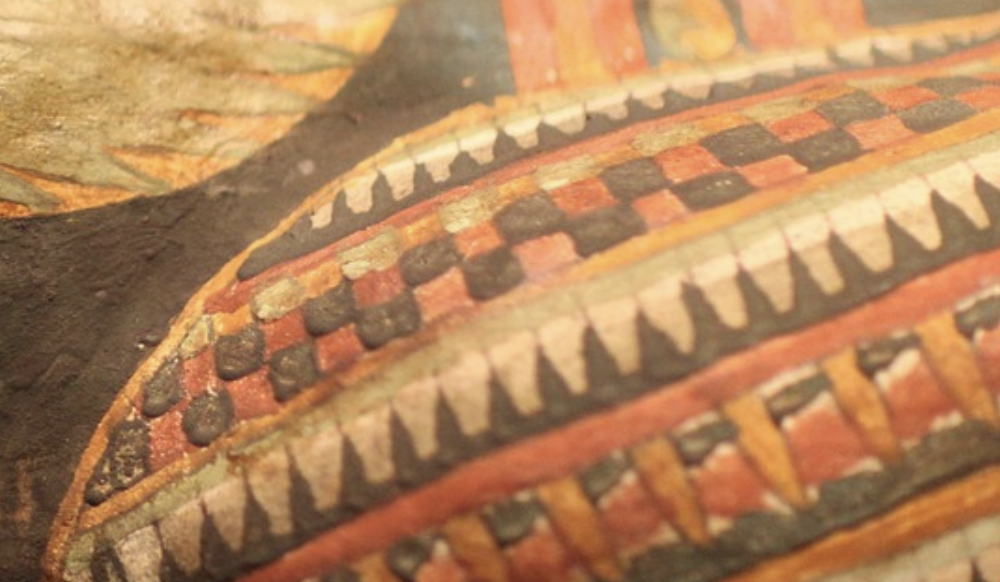
It is a coffin in Egypt.
“Joseph saw Ephraim’s children to the third generation; the children also of Machir son of Manasseh were born on Joseph’s knees. Joseph said to his brothers, ‘I am about to die. God will surely take notice of you and bring you up from this land to the land that God promised on oath to Abraham, Isaac, and Jacob.’ So Joseph made the Israelites swear, saying, ‘When God takes notice of you, you shall carry up my bones from here.’ Joseph died at the age of one hundred ten years; he was embalmed and placed in a coffin in Egypt.”
Genesis (50:23–26):
“Be strong, be strong, and we will all be strengthened” we say at the end of a book of the Torah, and we need it at the end of this one. Why would the Torah choose this moment of death to end its first book?
These verses close the story of Genesis and open the story of Exodus.
Maybe they are here to teach us about exile, slavery, hope, and redemption, all before any of those things even begin.
Earlier in Parshat Vayechi, Jacob asks Joseph to bury him in the Land of Canaan. Joseph promises and after his death Jacob’s body is brought out of Egypt and buried with his ancestors.
When Joseph is about to die, something is different.
Joseph does not ask to be buried in the land right away. Instead, he says:
וְהַעֲלִיתֶם אֶת־עַצְמֹתַי מִזֶּה
V’ha’alitem et atzmotai mizeh
“You shall carry up my bones from here.”
Joseph knows something that his father did not need to face: our family is no longer temporarily visiting Egypt. We are well and truly in galut - in exile.
Rabbi Jonathan Sacks (z”l) explains that Jacob still lived in a world where movement was possible. Joseph represents a new stage in Jewish history. The Israelites are settling, growing, and becoming dependent on Egypt. Maybe they even understand themselves as Egyptian in some ways.
That’s why Joseph talks about bones (atzmot), not burial. Bones last. They remain even when bodies cannot move. Joseph understands that he may not return to the Land promised to his people in his lifetime - but he refuses to let go of the connection. There are times like this, times we may be stuck somewhere we don’t want to be without the power or capacity to change our circumstances. Joseph has experience with that, and in his death teaches that even when we are stuck physically, we do not have to give up spiritually. One way we do that is by remembering who we are.
Rabbi Danya Ruttenberg teaches that memory is an act of resistance. By knowing who he is and by asking his people - our people - to remember him, Joseph is resisting the idea that Egypt is the final chapter and also Egypt’s insistence that it gets to tell him who he is and us who we are.
Exile, the Torah teaches us, does not mean forgetting who you are and it does not mean erasure.
At least, it doesn’t have to. What the circumstances are now, whatever they are, good or bad, are temporary. We are here for the long game, and in the long game we rely on knowing and memory.
Joseph’s final words include a phrase that appears twice:
פָּקֹד יִפְקֹד אֱלֹהִים אֶתְכֶם
Pakod yifkod Elohim etchem
“God will surely take notice of you.”
“Pakod yifkod” is a repetition of the same verb with the pey-kuf-dalet “take notice” root.
In Hebrew, repeating a verb shows emphasis and certainty. It is an exclamation point.
Joseph is not guessing.
He is not asking.
He is making a promise.
God will take notice.
On what evidence is Joseph making this promise?
How can he know so emphatically?
How can he be so sure the Israelites will one day be redeemed?
Maybe good leaders do not only respond to the present - maybe they prepare people for the future. Maybe Joseph understands Jewish history. He knows about God’s covenant with Abraham, which included both suffering and redemption.
Rabbi Jonathan Sacks (z”l) teaches that “faith is not about optimism but about courage, the courage to face an unknown future knowing we are not alone, that God is with us, lifting us when we fall, signalling the way. Joseph is not saying, “Everything will be fine.” He is saying, “Even when things are not fine, God will still be there.” He plants the idea of redemption before slavery even begins. That way, when things get hard, the people already have a story to hold onto.
The Torah makes sure we notice this connection. In Exodus 13:19, when the Israelites finally leave Egypt, we read:
“Moses took the bones of Joseph with him, because Joseph had made the Israelites swear…”
And after the Torah in the book of Joshua 24:32 the Israelites bury Joseph’s bones which they had “brought up from Egypt” at Shechem in the tract of land that Jacob bought from Hamor, the father of Shechem.
The same bones. The same promise. The same phrase.
Redemption does not come out of nowhere.
It grows from memory, faith, commitment . . . and miracles.
One of my students was thinking about miracles in preparation for Chanukah a few weeks ago and he said he thought maybe a miracle is something that two or more do together that they could not possibly have done on their own. “You know,” he said, “like surviving and not assimilating and cleaning the Temple and finding that jug of oil and then deciding together to light it.” Then he continued, “And maybe also even just pressing olives into oil in the first place. Maybe that’s also a miracle, that we can make oil from an olive.”
Joseph wasn’t satisfied, though, with just giving his people a hopeful message. A message about the future, he knew, would not be enough by itself to guide people through an impossible present.
So he makes them swear:
וַיַּשְׁבַּע יוֹסֵף אֶת־בְּנֵי יִשְׂרָאֵל
Vayashba Yosef et b’nei Yisrael
“Joseph made the Israelites swear an oath.”
In the Torah, an oath is particularly serious stuff. It’s binding.
Generations will pass. People will forget details. Life will get hard. Slavery will make hope difficult. Maybe impossible. But an oath . . . an oath the people will keep.
So when the final verse of Genesis says:
“Joseph died… and was placed in a coffin in Egypt” Joseph has made his coffin and his own bones a physical reminder that Egypt cannot be forever because Joseph is counting on them to carry his bones out and that they swore an oath that they would do it.
The book of Bresheet - of Genesis - doesn’t end with a resolution.
It ends with waiting.
And Judaism is comfortable with unfinished stories, but we also know this story isn’t over. We know that sometimes the most faithful thing we can do is turn the page . . . and that when there is no page to turn we must take up a pen and write another one.
It is with that faith that the Israelites will carry Joseph’s coffin through many generations of slavery, through the desert, and eventually into the Promised Land. Something none of them could possibly do on their own. Something that could only be done together.
Joseph could not walk into freedom.
However, Joseph - and his story - can be carried there.
The book of Genesis ends with exile and faith.
Death and promise.
A coffin and carried bones.
Joseph stands at a turning point of Jewish history.
Behind him is Bresheet: our creation story as a family.
Ahead of him is Shmot: our journey to become Am Yisrael - the Jewish People.
I can feel the miracle waiting for us at the end of Genesis in my bones -
A miracle that will only happen when people do together what none of them could have done alone.
A fierce communal strength that is waiting to be born.
חָזָק חָזָק וְנִתְחַזֵּק
Chazak, chazak, v’nitchazek.
May we be strong when the future feels far away.
May we be strong when the journey is unfinished.
And let us strengthen one another as we turn the page
and move forward together.