Holding Onto Herself: My Review of The Ghosts of Rose Hill by R. M. Romero
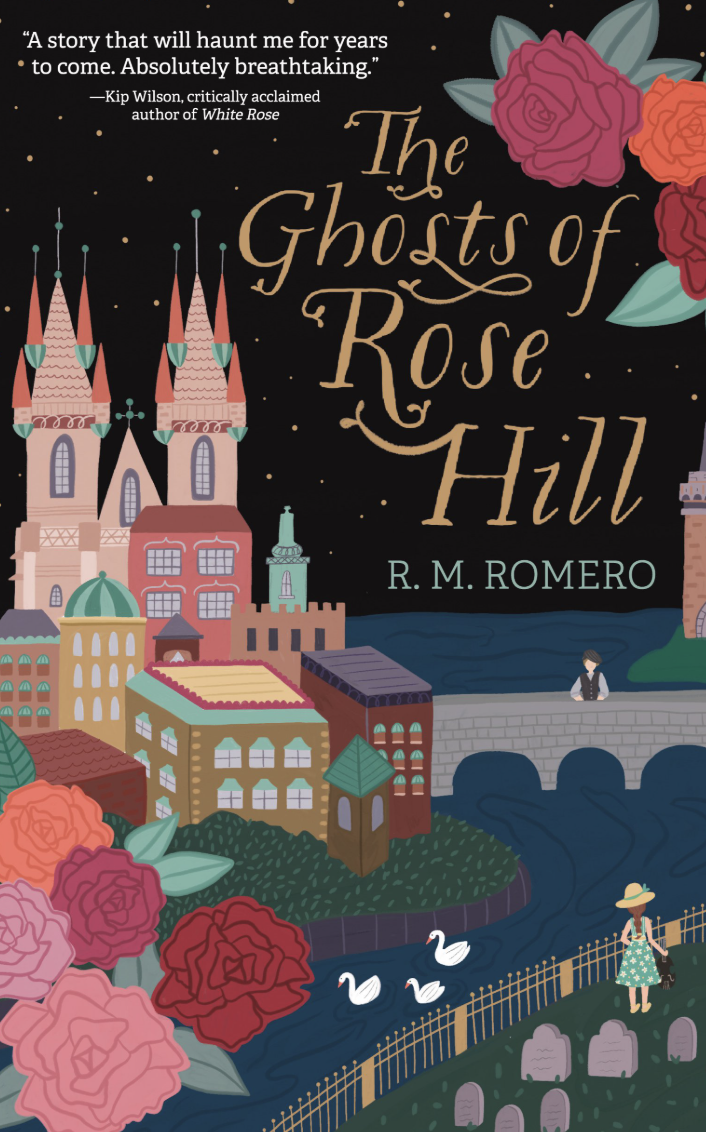
Fairy tales were never meant to be sweet children’s stories. They were communal narratives that allowed societies to grapple with abandonment, death, violence, and exploitation. In the tales collected by Jacob and Wilhelm Grimm, for example, wolves and witches and wicked stepparents stood for predatory adults, hunger, and social vulnerability. Story became a place to explore the risks facing young people, and by positioning terror inside magic and metaphor tales created enough distance for listeners to confront frightening truths safely.
That is precisely what makes a modern, mystical novel like The Ghosts of Rose Hill such an effective vessel for exploring trauma, exploitation, moral courage, and the strength of knowing who we are.
In this lyrical YA novel-in-verse, 17-year-old Ilana López takes center stage. She is the daughter of a Sephardic Jewish mother from Cuba and a non-Jewish Czech father. Both parents fled communist dictatorships and are raising their daughter in multicultural Miami. Reacting to what they perceive as Ilana’s friends distracting her from academic achievement, they send her to live with her aunt - her father’s sister - in Prague for the summer. Angry, defensive, and unsure of where she belongs, Ilana takes herself for a walk and encounters an uncared for Jewish cemetery on Rose Hill. Chesed shel emet, which translates as “True Kindness” is the mitzvah of caring for a Jewish cemetery. Upon entering the grounds, Ilana is moved - almost compelled - to straighten stones and clear weeds. When she asks her aunt for permission, Ilana hears that honoring her ancestors and fulfilling a sacred, communal, and Jewish responsibility to the dead is not something she needs to ask permission for. Then she falls in love . . . with Benjamin . . . a ghost.
Through mystical encounters, family reckonings, and moral courage, Ilana confronts trauma, reclaims her voice, holds onto her Self, and chooses who she wants to become.
For Jewish parents, educators, and rabbis, this book sits at a powerful intersection: it is a fairy tale steeped in Jewish history and mysticism, and it speaks directly to contemporary issues. It is poetic and haunting, romantic and painful, and it is rooted in Prague’s Jewish past while urgently modern in its concerns.
It is important for me to be clear: this novel - I think very appropriately - raises themes of grooming and sexual predation. The character Wasserman is portrayed as a classic child sexual predator. He is a vodník, an evil water spirit, in human form. This character literally and spiritually feeds on the souls of dead children, and when he comes for Ilana he becomes her nemesis. Wasserman is charming, manipulative, attentive to vulnerable children, and skilled at isolating them from trusted adults. He uses flattery, gifts, and emotional manipulation to create dependency and control. While the book contains no graphic sexual content, the psychological dynamics of grooming are unmistakable.
I write this as both a warning and an opportunity.
The novel can open meaningful conversations about:
Recognizing inappropriate adult attention
Understanding manipulation and coercion
The difference between romance and exploitation
Trusting one’s instincts
The importance of safe adults and community
Wasserman is not romanticized in any way. His predation is exposed as evil and corrosive and Ilana fights him with clarity, courage, strength, and love. The love of her parents, the love she and Benjamin share, her love of Judaism, and her love of herself.
In a world where teens encounter predatory behavior online, in person, and in the news, this narrative provides language and moral framing without sensationalism. Critically, the story insists evil can be named, resisted, and defeated.
The ways Romero uses Jewish folklore to hold hard truths is powerful. The legend of the Golem - traditionally associated with Rabbi Judah Loew of Prague - hovers over the narrative. The Golem story itself is about protection: a being created to defend Jews from violence, but whose power carries danger. Romero draws on that tradition to explore what happens when protection fails, when danger comes not from mobs but from trusted insiders.
The novel also includes Czech and Jewish folkloric elements, including the water spirits known in Czech lore as vodník (water goblins or demons who dwell in rivers and lakes). These beings, eerie and morally ambiguous, add to the fairy-tale atmosphere and mirror the hidden currents of danger in Ilana’s life. The mystical elements create distance and symbolism, allowing readers to approach trauma obliquely.
The verse format also supports the fairy tale. The poetry reads like incantation and confession, prayer and diary. For Jewish readers, the cadence may feel familiar as it echoes Lamentations, Psalms, and whispered stories shared across generations.
Romero also braids together Holocaust memory, intergenerational trauma, and diasporic identity. Prague’s Jewish quarter is not merely a backdrop; it is a character. The weight of history presses in - the old cemetery, the legends, the erased lives. Ilana, as an American Jew with Sephardic ancestors, navigates multiple strands of Jewish identity at once. She is angry. She makes mistakes. She feels alienated from her parents and from her tradition. At the same time, her Jewishness is essential to her strength. After all, the water demon’s story may be old, but her stories - her Jewish stories - are even older.
The Ghosts of Rose Hill supports YA readers in developing their Jewish identities in several ways:
It portrays Jewishness as layered and evolving. Identity is not reduced to synagogue attendance or ritual observance. It includes language, memory, food, stories, and inherited resilience.
It connects teens to Jewish storytelling traditions. The Golem legend becomes a living metaphor, not a museum artifact. Readers encounter Jewish folklore as dynamic and relevant.
It centers moral agency. Jewish identity here is bound up with ethical choices such as choosing truth over secrecy, courage over compliance, self-respect over flattery, and protective action on behalf of someone more vulnerable.
It validates struggle. Ilana’s doubts and anger do not disqualify her from belonging.
At the same time, The Ghosts of Rose Hill is a valuable book for non-Jewish readers. It provides an accessible entry point into Jewish history and identity.
Through Ilana’s eyes, readers encounter:
The persistence of antisemitic violence in European history
The spiritual and cultural richness of Jewish Prague
The emotional reality of diasporic identity
The role of folklore in preserving communal memory
Jewish life is shown as creative, mystical, humorous, wounded, and resilient. For non-Jewish teens, this can broaden understanding of Jewish storytelling as a living tradition of myth, poetry, and moral inquiry.
Of course, I also set the Spill the JEWce book club calendar, and I chose discussing this book in proximity to Purim for reasons. There is a striking resonance between Ilana’s journey and Esther’s. In Megillat Esther, a young Jewish woman on the brink of adulthood is caught in a web of power, danger, and sexual exploitation within a royal court. She is vulnerable in a foreign environment. She is targeted by a powerful adult who exploits asymmetries of age and authority. She is chosen, evaluated, controlled, and placed at risk. Yet Esther ultimately claims her voice, declares her identity, and acts to save herself and her people. Her assertion of self is an act of strength.
Romero’s novel affirms that Jewish storytelling can hold darkness and hope together. Through it she tells us our voices matter, that our heritage is alive in us, and that part of loving and being loved is sharing our stories with each other.
Finally, The Ghosts of Rose Hill by R. M. Romero and Rules for Ghosting by Shelly Jay Shore are remarkably different books in so many ways, but I do love both of them for their awesome Jewish protagonists and ghosts who don’t follow the rules. We read Rules for Ghosting a couple of years ago in Mo’adon HaSefer - my occasional adult book series. For mature teen and adult readers, I think they could be very interesting to read and discuss together.
Happy Reading.
Discussion Guide
Trusting Our Instincts
That gut feeling: Have you ever had the visceral sense that someone wasn’t safe - even if you couldn’t explain why?
What were the “red flags” in Wasserman’s behavior, and when do you think Ilana first sensed that something was off?
Discussion of specific behaviors (isolation, secrecy, flattery, gift-giving, boundary-testing).
Normalize intuition: “Our bodies often notice danger before our brains catch up.”Wasserman is charming, generous, and attentive in ways that could seem flattering at first. At what point does attention turn into manipulation?
Manipulation is about power.
It is not romance and is certainly not about love.Creating secrecy (“Don’t tell anyone.”)
Special treatment/gifts to create dependency
Testing physical or emotional boundaries
Isolating from peers or family
Ilana doesn’t immediately tell a trusted adult what’s happening. Why do you think that is? What makes it hard - even for smart, strong teens - to speak up sometimes?
Outside of the book, in real life, what are some ways someone your age could call in some back up if they met a Wasserman?
Trusting our discomfort is POWERFUL.
Age, Agency, and Responsibility
Ilana is an older teenager. She’s 17. Does her age matter when she decides to try to save Benjamin and the other kids? Would her choices feel different if she were 13 instead of 17? How does age affect responsibility, risk, and courage?
Jewish tradition teaches pikuach nefesh - the obligation to save a life. Do you think Ilana sees herself as responsible for protecting others? How does her Jewish identity influence her decision to act rather than stay silent?
Jewish Identity, Memory, and Care for the Dead
Prague’s Jewish cemetery and the presence of ghosts play a major role in the story. In Judaism, caring for the dead (kavod ha-met) is a sacred duty. How does Ilana’s relationship with the past - and with the dead - shape her sense of self?
The novel weaves Holocaust memory and intergenerational trauma into a contemporary teen story. How does remembering Jewish suffering in Europe affect Ilana’s understanding of danger, survival, and resilience?
The Golem legend is a story of Jewish protection. In a world where Jews have often been unsafe, what does it mean to imagine creating a protector? How does that legend connect to Ilana’s role in the story?
Magic, Folklore, and Meaning
The novel includes mystical elements - ghosts, Golem, and water spirits (like the vodník of Czech folklore). How do these magical elements help tell a story about very real dangers? Why might Jewish storytelling use myth and mysticism to talk about trauma?
Form and Voice
The book is written in verse. How does the poetic style affect your experience as a reader? Does it feel like prayer, lament, prophecy, or something else? How does the form shape the emotional intensity of Ilana’s story?
If Ilana and Benjamin were here with us, what would you want to tell them?
If your YA reader would like to join our discussion on Sunday March 1st, please let me know!